 Eterno Dia Photography
Staycation Alberta: Chasing Comets
Posted on July 28, 2020
Comet Neowise surprised astronomers when it was discovered in March of this year. It became popular with the space community and lay people when in July, the comet came close enough to earth the be viewed with the naked eye, or at least a set of binoculars.
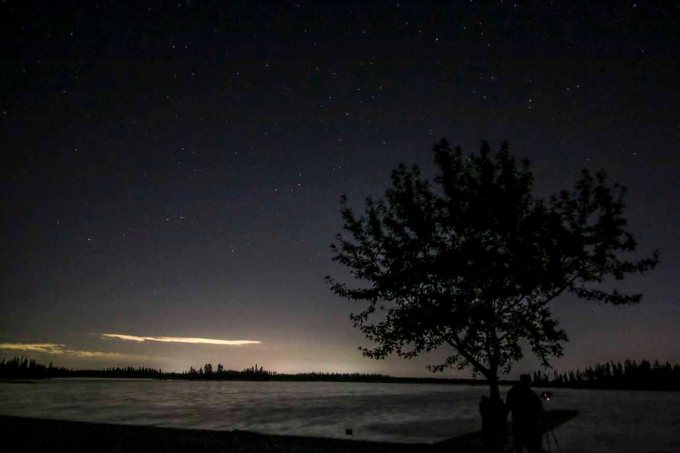
Astotin Lake, Elk Island National Park
I had trouble, between Edmonton’s recently very stormy skies, and my myriad of day jobs, finding a chance to head out to hunt for Neowise. Finally, last weekend, I had the time and was blessed with clear skies, so my husband entertained my insanity and we headed 45 minutes east of town to Elk Island National Park, our closest dark sky preserve. We arrived at the park just before midnight as the moon was setting. Even though I was late in the game in terms of catching the comet in its easy viewing phase last week, there were still lots of other folks out in the park that night; stargazers with telescopes far more impressive than mine, astrophotographers, and families enjoying the pleasant July evening.

Watching the setting moon at Astotin Lake in Elk Island National Park.
I’m a photographer, but astrophotography is a whole entity of its own. I follow a lot of communities: The Alberta Aurora Chasers and the Royal Astronomical Society of Canada, just to name a few. The photos from their members are always stunning, but I have ABSOLUTELY NO IDEA what they’re talking about when it comes to equipment and editing. In preparation for trying to capture Neowise on film, I just watched some YouTube videos about how to capture it on a DSLR. I set my camera to the suggested settings before we headed out so that I’d have an idea of where at least to begin so I’d have a chance.

A tiny red meteor streaking though the sky. Red means that the composition is nitrogen and oxygen.
Comet Neowise was no longer naked eye visible, so using all the internet’s suggestions of how to find it, we found a good viewing spot, and started searching with the binoculars. Eventually I found a “smudge”, and Shawn and I both agreed that that was most likely a less than impressive comet. I set up my camera, skeptical I’d even be able to computer it on film, since I couldn’t see it, but I was shocked when I looked at the camera’s screen to have a tiny green comet with a hazy tail appear.

My first glimpse of the Neowise, just below the Big Dipper.

A fellow stargazer looking through a telescope.

Comet Neowise just below the big dipper.
While we were out that night, as it grew darker (the sun never fully goes to bed this far north in the summer time), I set up my telescope and we gazed at golden Saturn, massive Jupiter and its four Galilean moons, and the tiny, red dot, Mars. I don’t have photos of those, as my telescope tech is outdated and doesn’t hook up to my camera. Due to the dark sky preserve, I was able to view the two larger planets as crisply as I’d ever seen them in my telescope, with Saturn experiencing its first summer in 30 years, and faint white and red lines just visible on Jupiter. We watched meteors streak through the sky every few minutes (the Southern Delta Aquariids and the Alpha Capricornids peak July 28-29 and the Perseid meteor shower peaks August 11-13). Did you know you can tell what a meteor’s composition is based on it’s colours? I even got photos of the Milky Way; the edges of our own spiral galaxy. I just learned that between June and August, earth faces to the inside of the Milky Way galaxy, which provides better views from the denser centre.
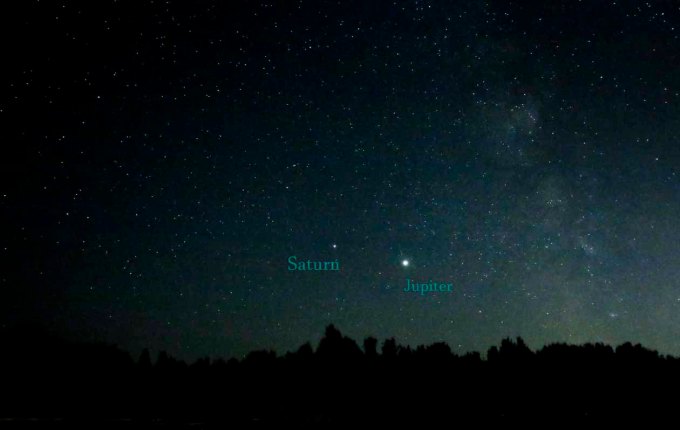
Jupiter and Saturn with the Milky Way starting to appear on the right.

A yellow/greenish meteor in this photo of a star cluster in the milky way, possibly made of iron or magnesium.

Our very own galaxy, The Milky Way.

We left at 2:30 in the morning, a bit chilled, very tired, but really satisfied that we were able to see so much. Since we’re all stuck relatively close to home this summer, get out into a dark sky and check out the awesomeness of space. We really are a pale blue dot in a vast expanse. The magnitude is hard to comprehend but it sure is stunning.

Another meteor streaking through the sky above the Big Dipper and Neowise.

Did you get a chance to see Neowise? What other space events have you been able to witness or capture? Thanks for stopping by and feel free to comment or ask questions! Happy travels!
– Leslie
Photos © Eterno Dia Photography 2020. Please contact for reproduction.
 Eterno Dia Photography