 Eterno Dia Photography
Phi Phi: Monkeys, A Famous Island and a Blue Lagoon
Posted on June 30, 2019
 The continuing saga of our epic adventure found us on our second day on the stunning island of Phi Phi and our seventh day in Thailand. This day began with my husband asking if I’d heard the monkeys in the night. I hadn’t, even with the windows open in our hillside cabin, I’d slept like a rock, and I’m glad I hadn’t heard them. Confession: I’m not a monkey fan.

View from our balcony
Some are cute, but I’d seen videos of the ones in South East Asia that rip open backpacks, strip off car parts and even attack people to get their food. Monkeys are smart (probably smarter than me), primal and can even have rabies. They make me uncomfortable. I was certainly weary about meeting any of these locals. Our tour guide had warned us that there were monkeys in the area and urged us not to leave food out on our balconies over night. When I went out onto our balcony that morning to check if the swim suits I’d laid over the rail the night before were dry, I froze; there was a monkey on the rooftop of the adjacent building, staring at me. Motion caught my peripheral vision and I noticed one in the grass down to the right and another on the roof with the first. They noticed me but didn’t seem to be closing in. I hissed for Shawn, who came out to see what I was upset about. We watched for a few moments and when we realized there was no immediate danger of being accosted by a monkey, I grabbed my phone for a few photos.


Monkey across from our room in the morning.

After we’d all seen enough of each other and the monkeys vanished into the forest, we went for breakfast at the hotel and then killed a bit of time shopping, finding lunch and exploring in town before heading back to the hotel for a late afternoon excursion.

More stairs. At least I’m staying in shape.

Morning view from the hotel.

Breakfast view. Perfection.

A beautiful quiet morning. While all the partiers sleep, we explore the residential parts of Phi Phi.
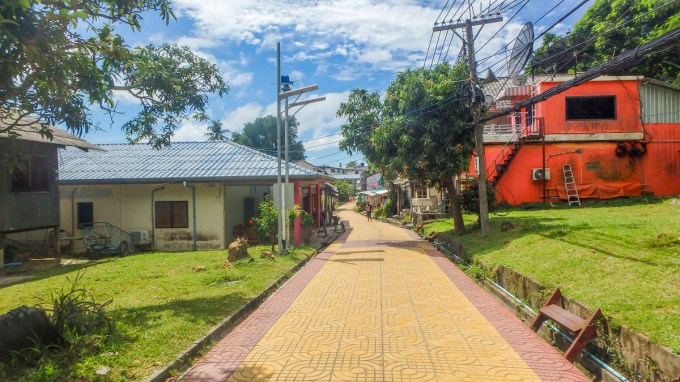


Orange Bougainvillea.

Thai spirit tree. It’s believed that spirits reside in old trees. Offerings are often placed at the base and ribbons adorned on them.
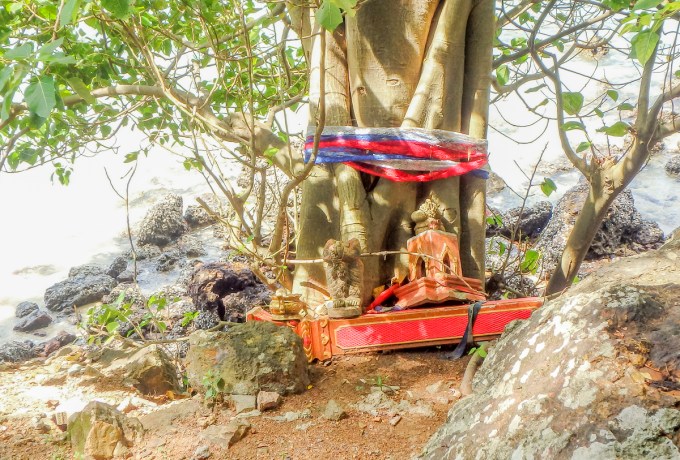
Spirit tree


sign outside a dive shop

Morning shopping in Phi Phi


Our tour guide had helped the group arrange a snorkeling tour for the group. Two wooden boats came to the beach of the resort and we loaded up. First stop: the ominously named “Monkey Beach”. Super…. A short boat ride to the other peninsula on the opposite side of Phi Phi Don and we arrived on the shores of monkey beach and it was exactly as the name described. Monkeys. Everywhere. Macaque monkeys are the type you’ll find here; grey-ish brown, adults about two feet tall and 15 or so pounds.

Arriving at ominously named “Monkey beach”.

Well, here are the monkeys…


Ok, I admit it, the babies are kinda cute.
Monkey beach was a bit of a conflict for me. It’s a tourist attraction to be sure. The monkeys are quite used to people and are generally laid back, but unfortunately there have been documented incidents, including monkey bites. These can be exceptionally serious, as monkeys can have rabies, not to mention any other manner of infection from a bite in a place with foreign water and bacteria. I would say that a large number of tourists we saw during our short visit didn’t show proper respect for what is WILDlife. Some people were kicking water at the monkeys and teasing them with food. This is an excellent way to get attacked and potentially seriously injured. Not to mention, it’s cruel. While very cool (and somewhat terrifying personally) to see this many wild monkeys, I stayed very aware of where they were and made no effort to touch them. I took pictures at a distance, didn’t engage with them and I didn’t bring food for them. One larger male gave my husband’s swim trunks a thorough search and at one point attempted to remove them entirely, just to be sure there was no food. I think tourists should really be taught and reminded that the monkeys are wild and need to be treated with respect. I would caution everyone interested in coming here to be careful, not to bring food or tease them, and at worst, be prepared for a bite. It does happen.

Monkey bite first aid instructions in the boat.
We stayed on monkey island for about 10 minutes, which was more than enough for me. Our next stop was the island of Koh Phi Phi Le. You may have heard of this island when it was made famous as the film location for the 2000 movie, “The Beach” starring Leonardo DiCaprio. A large portion of the movie was filmed on Phi Phi Le. To make a long story short, the producers made a lot of changes to the island (to make it even more paradis-ey) which was never properly reclaimed afterwards, as promised. Then during the tsunami and the last typhoon, the island and its coral took a serious hit. On top of that, tourism to the tiny island exploded after the film causing huge damage to it’s main beach in Maya bay, so in 2017, the Thai government shut it down to give it a chance to recover. The good news is that is seems to be helping; white tipped reef sharks have been seen returning to the bay and some accounts say the coral is showing signs of recovery.

Mysterious Phi Phi Le in the background.

Phi Phi Le. I’m still thinking Jurassic Park.

Just wow!

Fortress-like. Land of the lost anyone?

We arrived at Koh Phi Phi Le and began to circumnavigate around it. There are few places you’re actually allowed to set foot on the island. We jetted around the island for some time, taking in the beauty of the island’s craggy limestone cliffs.

Daunting and spectacular

Sama Bay

Sama Bay

Sama Bay


Maya Bay from the movie “The Beach”.
We weren’t allowed to step foot on the Maya Bay beach, the famous beach from the movie, and there was a constant coast guard presence there to ensure no one did, but we were allowed to snorkel adjacent to it. Our tour guide assured us that the snorkeling here was amazing. I was ready. Or so I thought….

Sergeant majors everywhere. They might nibble lightly. Feels a bit like a tiny electric shock. I settled down when I realized I wasn’t being stung by jellies.


To make another long story short, my underwater camera battery failed me on this trip. It was working fine during the first part of the snorkel, which was in deep water but I couldn’t see much anyway. When the battery died, I was upset, but to that point there hadn’t been much to see, and what we’d seen on our dive a few days earlier was so much better, so I decided to try to not freak out and let this ruin the trip. This was nothing I hadn’t seen before, I told myself…. It was a moment later that suddenly the water started to become shallow as we got closer to shore and THE MOST GORGEOUS FISH I’D EVER SEEN began to appear; parrotfish, wrasses, angelfish, pipefish and coral in every spectrum and colour of the rainbow. I moaned into my snorkel mask, holding back tears for what had just become the most amazing snorkeling I’d ever experienced in my life. It was like swimming in a display aquarium. I could here the crackling noise of the parrotfish munching on the coral and watched the fish chase each other and even swim right up to investigate me. I made a choice in that moment, that even though I was devastated about not being able to document it, that I would do my best to ENJOY that precious moment. We reached the shore and I was trying not to be envious of the people in the tour who’s Go Pros had worked beautifully. We took a group photo on the stunning small private beach and then hopped back in the water to return to the boat and I tried to savor every amazing moment. I don’t know if I’ll ever truly be OK with the fact that I didn’t capture the moment, but it was truly the one of the most incredible experiences of my life.
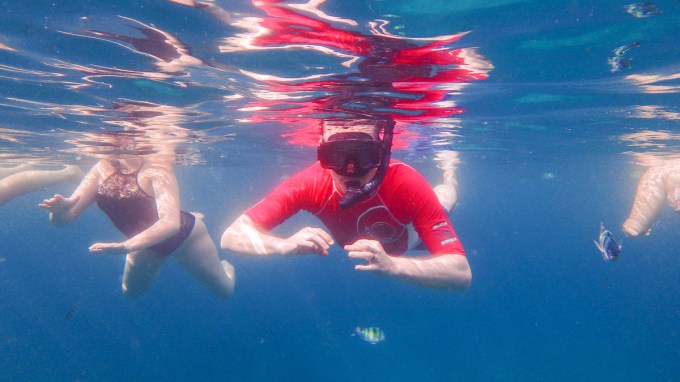
Shawn having a snorkel at Maya Bay

One of the few SPECTACULAR fish I did capture before my battery failed. Bluelined or Striped surgeonfish.


A painting in our room that accurately represents what I saw snorkeling in Maya Bay.
Once back on the boat, experiencing a mix of emotions ranging from the exhilaration of the snorkel to the devastation of the battery failure, we carried on to continue our circumnavigation around Phi Phi Le. In the late afternoon heat, a thunderstorm had come up and all of the nearby tour boats tried to outrun it and make it back to the main island. The captains of our two boats decided it would be safer to try to shelter and pulled into a crevasse into the side of Phi Phi Le that led to a hidden lagoon surrounded by giant limestone cliffs.

An approaching thunderstorm that we won’t be able to outrun.

Thunderstorm. We need to find shelter.
 Besides one other small speed boat that also found shelter in the lagoon, called Pileh Lagoon, we had the place to ourselves. We huddled under the tarp roof and the boat crew fed us fruit and drinks while we waited for the rain and wind to pass. When the weather settled and the sun same out again, the boat crew encouraged us to enjoy some time swimming in the lagoon. The group had begun to lose its zest after the chill from the storm.


giant cliffs rising above us in Pileh Lagoon

Waiting for the thunderstorm to pass. Don’t touch any metal on the boat…


Pileh Lagoon is gorgeous.
I was starting to worry this would be a repeat of the excursion a few days earlier when our snorkeling trip got cut short. Either way, by this point, I had to pee and I was not going to hold it. On a previous vacation, I’d had a similar problem on a boat with no bathroom and held it way too long. I was in absolute misery by the time we got to a bathroom and it had really zapped my enjoyment of the trip, so I didn’t want to remember this day in the same way. To hell with it; I announced that I was going to go in the water and everyone on the boat looked at me like I was crazy. I was done trying to impress the others on the tour and decided to just tell them; I was going in to have a pee and requested them to kindly not watch. I’ll spare you the details, but the lagoon was amazing! The water was perfect, the towering cliffs surrounding us were majestic and it felt like a paradise. A few in the group inquired how the water was and I told them it was amazing and encouraged them to join me. Before long, nearly 20 of us were floating and playing in the water. We joked and told stories and compared our buoyancy rates and the directions we floated individually in the water. We played in the lagoon for about an hour before boarding to finish our trip.


The group swimming in the lagoon once the storm passed.

Thai long-tail boat

Boats are also adorned with ribbons to honor spirits and give protection.

Long-tail boats from the lagoon

Stunning
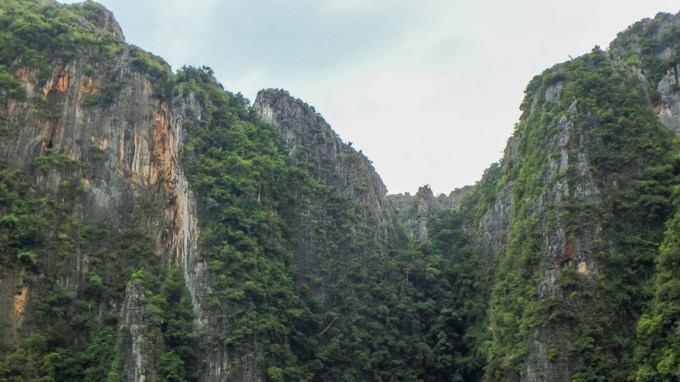
Did I say Jurassic Park?
After we were finished floating in Pileh Lagoon and on our way back to Phi Phi Don, we stopped near Viking cave to see where Thailand’s popular, but controversial and unproven medical aid “bird nest” is obtained by local workers (more about this in an future blog article). We watched a beautiful sunset and headed back to the hotel.

Viking Cave. Off limits to tourists, it’s one of the places where the birds nest for “Birds Nest Soup” is obtained.

Viking Cave


That night, we had our farewell dinner for the tour group and just as we were getting ready to head into town afterwards for some shopping or a bar, the rain began. The storm that rolled though earlier had been the precursor to what would be a long night of thunderstorms and absolutely torrential rain. We sat in the restaurant’s beach bar and contemplated rain gear and the long walk to town, but it was actually really nice to sit in the bar in the hot, humid evening and just watch the thunderstorm and the silhouette of Phi Phi’s mountains each time the lightning flashed. It had been an absolutely incredible day on the stunning island of Phi Phi. I was sad to have to leave tomorrow at the tour’s end as I felt we hadn’t had enough time to see Thailand’s stunning beaches, but there was still much of the country to explore and many more adventures to come. Little did I know that we’d only just scratched the surface of this place.


Hove you been to gorgeous Phi Phi? How did you enjoy it compared to the others areas? Too busy? Too rustic? Just right? Feel free to comment or ask any questions. As always, stay tuned for more updates, thanks for stopping by and until next time, safe and happy travels!
-L
Diving Into Thailand
Posted on April 1, 2019

I am not an experienced diver. I’m not certified. I only started to learn to swim 3 years ago; I took adult swim lessons at my local city pool when I turned 35. I love the water but I’m new at this. I’ve done a few “Discover Scuba” classes in the pool and my husband and I had a successful dive in Antigua about 3 years ago.

When planning our trip to Thailand, I knew we had to book a dive. While there are certainly other dive Meccas throughout the world, I know Thailand is pretty high up on the list. I booked our two-dive day months before the trip to make sure we would get the chance, as we had a pretty tight itinerary for our 21 days in Thailand. After some debate, we actually booked it for the first full day we were in Thailand. We knew we’d be exhausted from the 17 hours of flying, jet lag and culture shock, but I was confident I’d at least be healthy at the start of our trip, and I didn’t want to run out of time if our first week on the 7-day tour of the island area of Thailand ended up being too busy.
Even though we’d done a refresher discover scuba pool dive at home a few weeks beforehand, I was still really nervous; the ocean is a big place compared to a pool. We’d booked Aussie Divers in advance and it went perfectly from the moment the driver picked us up at our hotel to take us to the pier where we met our dive team of two and our other two fellow divers. We boarded a fairly large boat at the pier with about three other small dive groups. They supplied us with motion sickness tablets (if we needed them), served us a great Thai breakfast and our group went over the basics of hand signals and safety and gave us a general idea of what the day would look like. Afterwards, we had about an hour before reaching the Racha Yai dive site. I didn’t want to sunburn out on the top sundeck knowing I’d be in the water all day so I decided to take a few moments to myself for some relaxation and to calm my anxious nerves. The ocean is my favorite place to be, so what better place to work on myself and practice some mindfulness than during my short time at sea. I put my feet up, leaned against the wall of the booth on the boat and just took in the sounds and sensations around me:

A hint of diesel smell in the air
The dampness of the humidity on my skin
The noisy, chugging boat engine
The choppy waves
The rotating ceiling fan blowing air around the room
The blue of the sky out of the window
The vibration of the boat motor against my skull where I was leaning
The creaking noise of the boat with each wave
I began to feel the boat move with the ocean. I could feel the panels of the boat swell with each wave. I became suddenly aware it felt as if the boat was breathing with the rhythmic waves. I realized I was breathing with it. I closed my eyes and felt the boat and the ocean breathe around me. I felt so peaceful and present.
My session came to an end as we reached our first dive site and Shawn came to see if I was alright because I was alone in the cabin and not mingling on the deck. For a few moments, I had truly been alright. I hadn’t worried about the dive or heatstroke or sea sickness or any of my life worries. I just breathed. Peace.
The dives were amazing. Shawn and I each had a few moments of panic at different times, but the instructors, Darren and Craig, were both professional and helped us work through our issues. The fish were spectacular, the coral was far better than I’d been warned about due to recent storms and climate change. I’m really glad I didn’t know much about triggerfish until later… I’ll let the photos speak for themselves with only one final thought: Be kind to the ocean. Don’t litter, use biodegradable sunscreen and don’t harass the wildlife; it’s their home and we’re privileged to get to see from this view. Be kind to the Earth. We only have one home.


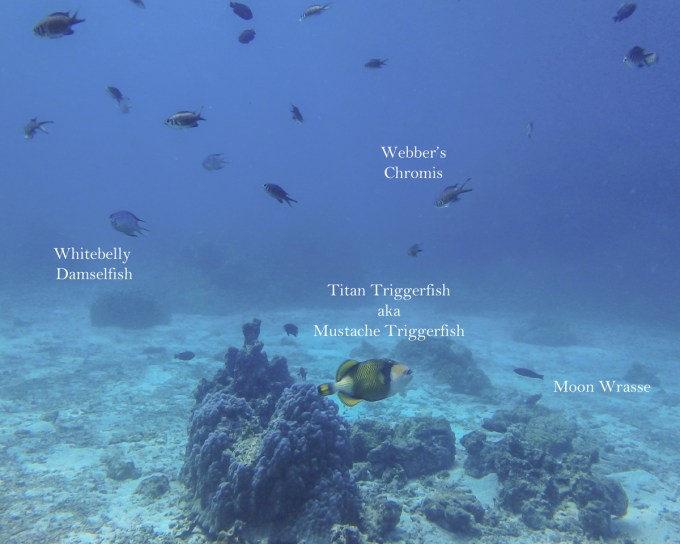
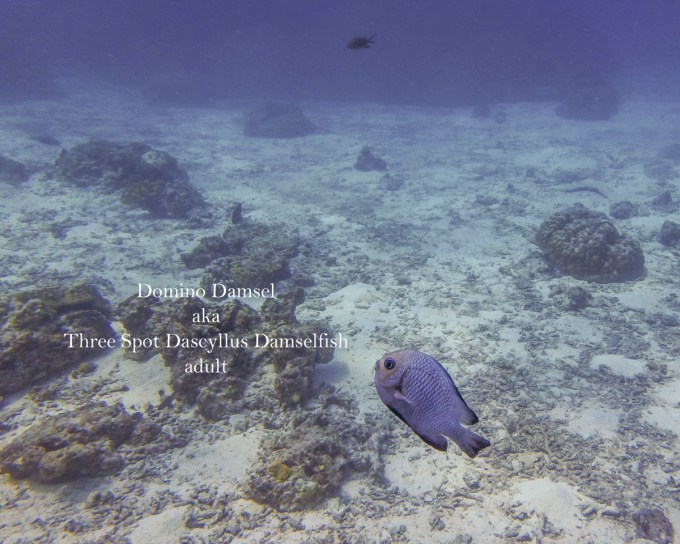

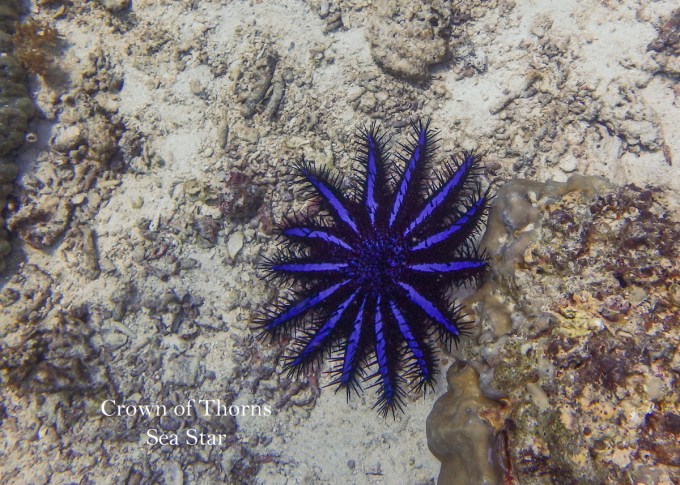


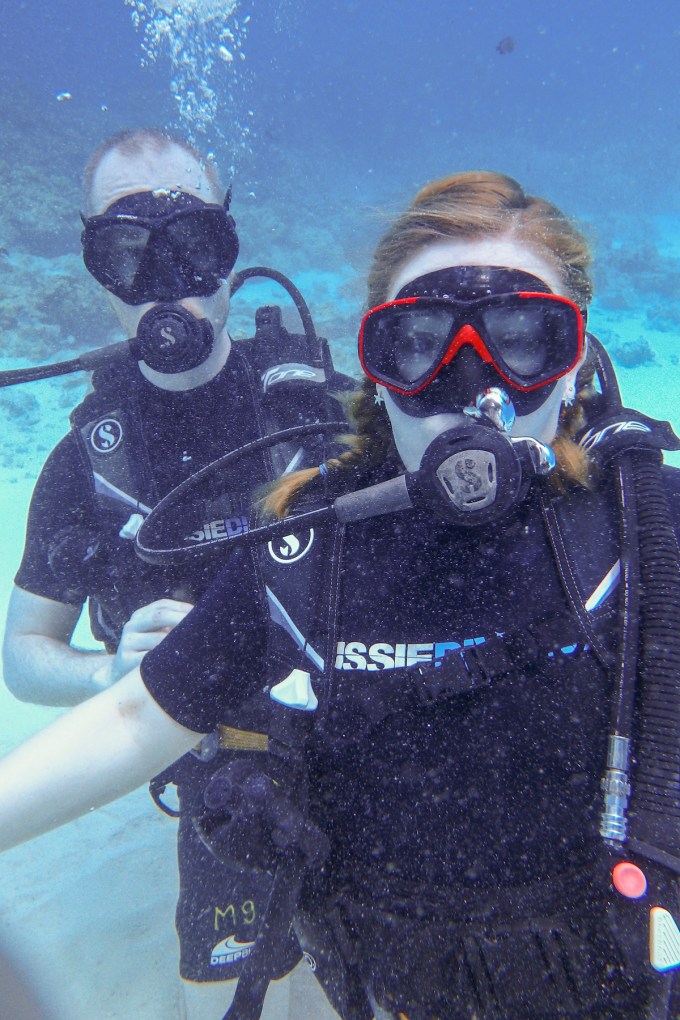
Fun fact: it took me weeks and weeks to research and figure out the names for all the fish we saw that day. Thanks as usual for taking the time to read and look at my photos. This was a really special day for us and I can’t thank Aussie Divers enough for an amazing trip. Stay tuned for more Thailand ramblings. Until next time, safe and happy travels!
Saltwater Dreams
Posted on May 25, 2015
I was born with sand between my toes, as the saying goes. I crave the ocean, sand, salt, palm trees and warm tropical beaches. Alas, I was born and remain landlocked in the prairies. In addition to the fact that I’m a landlubber, I also unfortunately reside in northern Alberta, where winters are long, dark and bitterly cold. Don’t get me wrong, Alberta is stunning; vast prairies, gorgeous Rocky Mountains, and the deserts in the south where you can find dinosaur bones. But the winter gets to me. It’s usually February or March that I crash and I start to do silly things like make extravagant purchases to make myself feel happy and alive. My saltwater fish tank was one of those purchases. It was February one year ago and I happened to be in a fish store that sold tropical saltwater fish. I stood in front of a tank that was filled with corals and anemones, a couple of clown fish. I was taken back to a snorkelling trip in Mexico. It was amazing to get a glimpse into the secret world of the sea. So warm and peaceful, floating there, watching the colourful fish live and play. That fish tank gave me the same feeling. I asked my husband, “Wouldn’t it be amazing to have a saltwater tank?” He agreed that it did feel like a mini vacation.
Since I’ve had my tank, I’ve been through some serious lows, and also some amazing highs. I post a lot of photos on my personal social media, and I get a lot of inquiries as to the commitment involved, and other questions. This article is to give you guys some information and some things to think about if you are interested in salt water as a potential hobby.
Time and Energy
A salt water tank simulates an ocean. Simulating the ocean in your home is not an easy task. There are many different water parameters that must be within a certain range to keep your fish/creatures healthy. Some of these parameters are Nitrate, Nitrite, PH, Ammonia and (of course) salinity. These parameters can be measured with at-home tests and must be checked at least weekly. Water changes are also a part of the deal; weekly as well as maintenance. Sometimes large (25-30% of the tank), emergency changes are in order if your tank has a crisis. This could mean mixing up a large batch of salt water in a hurry, or even having a reserve tank with salinated water at the correct temperature (this makes my water changes way easier). Marine fish need A LOT of time and energy. If you work 40 hours a week, have three small children and have a lot of extracurricular activities on the go, you may find the upkeep challenging. Patience is definitely a virtue in this hobby. A set up (the cycling process) takes 6 weeks. A “mature” tank takes close to a year. Introducing and acclimatizing new fish and critters takes days. Parameter changes need to be done slowly to make sure not to shock the fish.
Resources
Another thing to consider is what kind of resources you have available near you. The internet is a great place to start your research. There are plenty of forums and websites that have great information. You can learn a lot about what you might be in for. What about physical resources though? Do you live in a small town that may not have an LFS (that’s salty talk for “local fish store”) nearby? You probably need a place not only to buy your fishy friends, but also food, medication, testing kits, water additives, pumps, filters, salt, etc. The online world makes it pretty easy to get almost anything you need (including fish), but sometimes something critical breaks, and you may need a new filter pump in less than 24 hours. An LFS is also great since most employees work there because they have a passion for the hobby and many have personal experience with it. They are a great place to bounce ideas off of when you are having trouble with your parameters, and they can give you advice of types of fish and products that work for them.
Equipment and Financial Considerations
Most people in the hobby would probably tell you that 20 gallons is the minimum tank size you’d want to have to get into this hobby. 20 gallons won’t really get you many fish. You have to consider not only the size of the fish, how big they grow and how much swimming space they need, but also the amount of bio load they put into your tank. That basically means how much waste (poop) they create. The more fish you have, the more waste they make, the bigger tank you will need, otherwise your parameters will go out of whack. I have a 25 gallon tank and I have 4 small fish (that are considered “nano” fish because they won’t get too big), a couple of hermit crabs, a snail and a shrimp. I am at my absolute maximum bio load. If you want lots of fish, or big fish, you may need a tank in excess of 100 gallons.
That brings me to finances. The bigger the tank you want, the more equipment you will need. To get started, you will likely need a tank, tank stand, proper lighting geared towards reef fish and creatures, a filter pump (to filter organic waste), two powerheads for water flow (marine fish need much more water movement than fresh water – think ocean currents), a skimmer (helps to remove biological waste), a thermometer, a heater, sand or crushed coral substrate and likely, live rock (pieces of rock or dead coral from the ocean that will provide landscaping and hiding spots for your fish friends, but also helps to establish the basics of life in your tank. They come loaded with microscopic critters that help life to begin in your tank). And of course, let’s not forget salt. Salt is an ongoing expense as you’ll need to add it to any new water going into your tank. If you are starting from scratch, you can expect to pay $2,000 and up depending on the size of tank you want to start with. A word of warning; a marine hobby is not a place you want to cut corners to save money. I converted my 25 gallon fresh water tank to a salt water tank, so I already had quite a bit of equipment I listed above. I estimated that with the amount of equipment that I already had, that I would only need to spend about $500 to start my marine tank, but I ended up spending closer to $1000. I can tell you from experience that if you cheap out and decide not to buy the recommended supplies, or the cheapest equipment, you will likely pay in loss of fish. And they are expensive fish. Be prepared to do things the correct way, which is often the expensive way.
Crashes and Losses are Inevitable
No matter how careful you are, mistakes happen. Creating an ocean in a fish tank is difficult. Loss will happen. Sometimes it’s mechanical failure. A filter stopped working, or the heater malfunctioned. Maybe your parameters went south in a hurry. Your nitrate spiked and you weren’t home to do an emergency water change. Sometimes your critters don’t get along with your other critters. Maybe your crab gets a hold of your favorite fish. Sometimes it’s a mass extinction due to a fish disease or parasite that you didn’t catch in time to treat. Maybe that beautiful fish saw an opening and jumped to freedom, and you find him on the floor in the morning. Sometimes it’s a small loss, and sometimes it’s a mass extinction. There will be loss. It’s heartbreaking and you learn from it.
My Experience
I’ve had my tank for a little more than a year now. I have had a number of fish losses. However, I still have my original clownfish and yellow watchmen goby. They have put up with a lot from me and have proven to be very hardy. I have had moments of absolute devastation and hopelessness in this hobby. I have laid awake and had nightmares about this tank. I have had my fair share of problems, and spent way more money than I care to think about. My biggest issues have been getting my water parameters to settle. At the beginning it was my nitrate levels (caused by waste). In hindsight, I was guilty of overfeeding. For a really long time, my ammonia was dangerously high. Ammonia is toxic to fish and invertebrates. I lost a few lovely fish to my ammonia problems, and I learned some valuable lessons. It took me visiting quite a few stores and explaining my set up and parameters before one employee had a lightbulb moment and asked me about my cleaning routine. Evidently I had been keeping my tank “too clean” by scrubbing out all the algae and grime. With no algae, I had very little bacteria, and with no bacteria, the ammonia spiked. Bacteria is an essential part of marine life. There were times, before I figured out the problem, that I thought about tearing the whole thing down. I felt so bad for the fish; I felt like a failure.
Don’t worry, it’s not all doom and gloom. While I want those interested to get a real picture of the challenges, there is plenty of joy in this hobby. Marine fish are not only visually stunning, they are smart, playful and intelligent. They have vibrant and amazing personalities. I was bored of my freshwater fish, but I have never once been bored with my marine tank. I will often come home and sit for an hour, without realizing it, watching my clownfish play in a current. I watch my crabs turn over shells, and investigate new ones. I love coming in in the morning to discover that one has swapped homes and moved into a new shell. I love watching my grumpy faced yellow watchmen goby sift through the sand and puff up as someone swims too near to his cave. I love watching my cleaner shrimp try desperately to convince a fish to come near enough to get a cleaning. I love watching my six line wrasse hunt sneakily through the cracks in the rock for a hidden creature or morsel of food. I love how they interact with me when I come near the tank. The fish come right to the glass to greet me (or rather, beg me for food). I won’t tell you this is an easy hobby. I’ve found it to be a bit of a roller coaster. But now that I think I have things settled down a bit, I have what I saw that day in the store; my own little ocean escape. And a few fishy friends as well. I will promise you that if you do more research and decide you can devote the time and energy to it, you will fall deeply in love.
Click on a thumbnail to start slideshow


 Eterno Dia Photography